
Editorials
Why the Big Bug Craze Was Atomic-Age Horror At Its Best (And Worst)
How giant bugs like bloodthirsty spiders, kaiju-sized praying mantises, and more became the avatar of our collective Cold War fears.

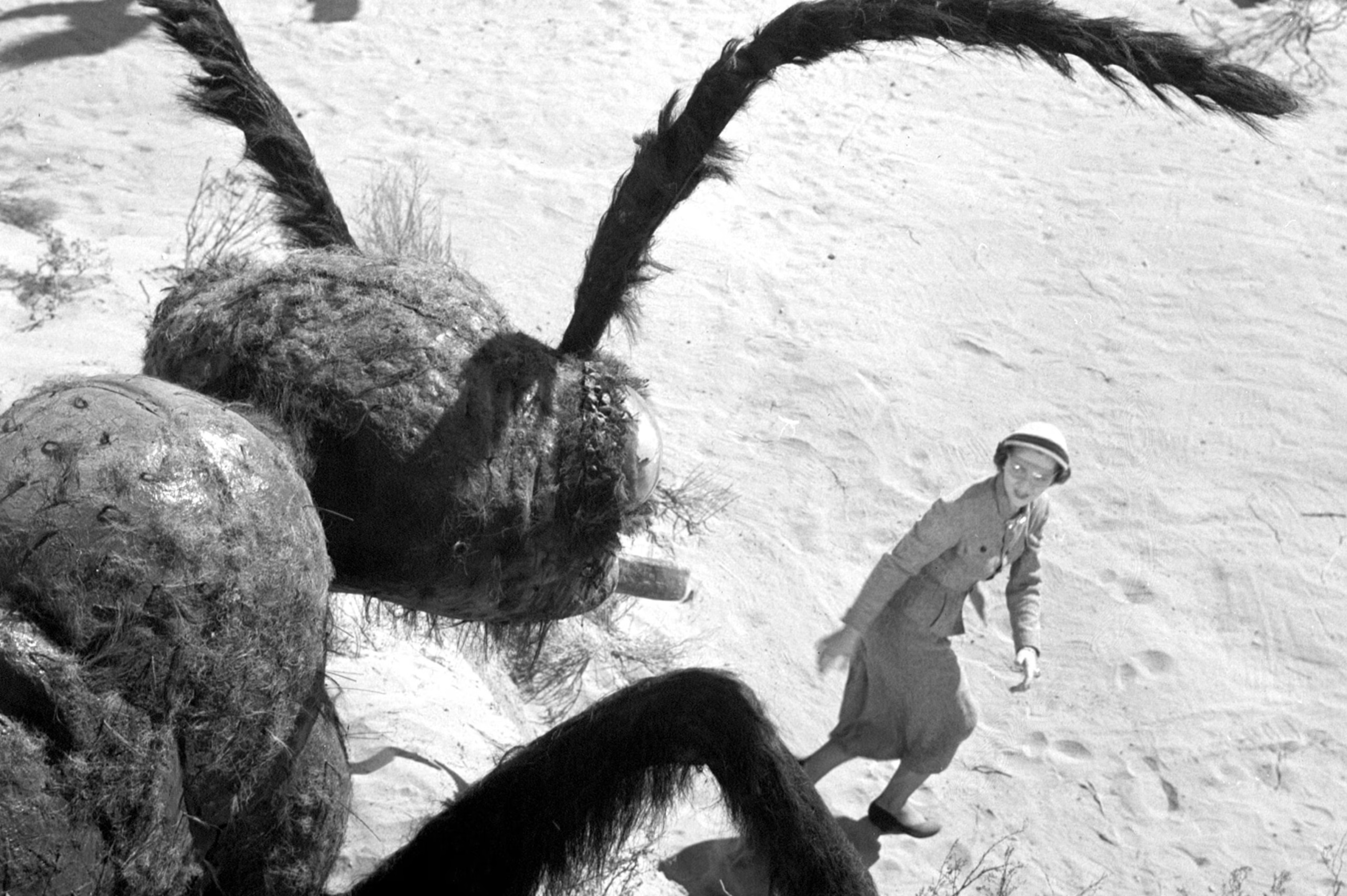
Few historical events had as immediate or pronounced an effect on the film industry as the atomic bomb.
Yes, it took a few years for that radioactive fallout to reach movie-goers, with the first hints of atom-age panic arriving in paranoid thrillers like 1950’s The Flying Saucer and apocalyptic visions like the following year’s Five.
It would take until 1953 for this proverbial mushroom cloud to settle, when Warner Brothers would unleash The Beast from 20,000 Fathoms on the American public.
The template-setting monster-on-the-loose film would be one of the studio’s biggest hits of the year (alongside Vincent Price’s horror star-making turn in House of Wax).
The Beast from 20,000 Fathoms’ greatest impact would be felt across the ocean, with its Japanese release inspiring Toho Studios to create a radioactive dinosaur of their own.
Domestically, Warner’s follow-up film would prove a far greater inspiration to filmmakers, with 1954’s horror-mystery Them! ushering in a wave of imitators that would swarm from everywhere, from major studios to burgeoning independent film titans to international producers.
How Them! Turned Atomic Fear Into Giant Ants
Image Courtesy of Warner Bros.
Though the trailer and poster advertised that Them! stood for “Terror! Horror! Excitement! Mystery!”, it really stood for giant ants, mutated by fallout from atomic bomb tests.
The film’s opening scenes took place outside Alamogordo, New Mexico, the closest town to the real-life White Sands missile testing range where the famed Trinity Test took place.
It resonated with audiences, who had already developed the (still latent) fear that splitting the atom was tampering with nature and inviting nature to remind man of his place.
Although the central conceit of Them! and its imitators—that radiation breeds sudden, startling mutation—is without scientific merit, the idea is too fundamentally frightening for a post-World War II audience to shake.
Radioactive mutation has become the vampires and ghosts of the modern world, a superstition that society laughs at but collectively engages in.
Like the religious and historical moorings of those old-world fears, these contemporary boogeymen are the skeletons in the closet of our cultural consciousness.
And with the threat of nuclear war a constant, looming background noise (even in Them!, where a background radio announcer would ask if the “Cold War is heating up”), no era was in greater need of voicing those subconscious fears than the 1950s.
Tarantula! and the Rise of the Giant Bug Movie

Image Courtesy of Universal Pictures.
All this to say, even if they didn’t apply the above critical thinking to why Them! was a hit, Warner’s rival studios were fast to cash in.
Universal was the first, turning Science Fiction Theater episode “No Food for Thought” into Tarantula! just a year after Them! hit theaters—even going as far as to copy the stylized exclamation point in the title from the Warner Brothers film.
In Tarantula!, the science-gone-wrong subtext of Them! is brought to the fore, with the bulk of the narrative concentrated on the experiments and the scientists that accidentally spawned the titular monster.
Unlike Them!, the science in Tarantula! was intended for the benefit of man: the experiment that births the tarantula was undertaken in hopes of creating larger breeds of livestock to solve world hunger.
Why they chose to experiment with a tarantula is never explained, and that’s perhaps for the better.
While Tarantula! did help to cement the giant bug subgenre, its greatest contribution to cinema history was less direct: it marks an early role for a young contract player at Universal named Clint Eastwood.
Eastwood appears in Tarantula!’s climax as a fighter pilot, and would later work with its star, Mara Corday, in several of his later Dirty Harry films.
1957: The Giant Bug Craze Explodes
Image Courtesy of Warner Bros.
Universal and Warner would both release follow-up big bug films in 1957, which also marked the first foray into the genre by independent producers.
Bert I. Gordon’s Beginning of the End featured giant grasshoppers, accidentally enlarged when they feed on a plant growth hormone created by well-meaning scientists.
At least this film clarifies that the giant bug is an accidental part of the process, which makes more sense than the experiments in Tarantula!
Bert I. Gordon, the producer/director/special effects director of Beginning of the End, would go on to specialize in these kinds of films, earning him the nickname “Mister Big”—also inspired in part by his nominatively-deterministic initials.
Universal’s The Deadly Mantis and Warner’s The Black Scorpion eschewed radiation for natural disasters, making their giant bugs into prehistoric relics reawakened after millions of years in hibernation.
The Black Scorpion is notable as one of King Kong effects artist Willis O’Brien’s last films, with urban legend even having it that some of The Black Scorpion’s stop-motion models were reused from King Kong’s mythical lost spider pit scene.
In a bizarre statistical anomaly, all three 1957 giant bug films were featured in episodes of Mystery Science Theater 3000.
The Monster That Challenged the World
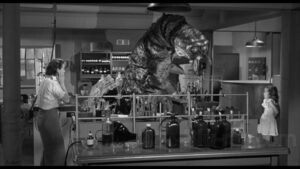
Image Courtesy of MGM-Amazon.
A fourth film from 1957 bears mention, though it only loosely fits into the “big bug” category.
The Monster that Challenged the World is a long-standing fan favorite with fifties monster movie aficionados (even earning an homage in Joe Dante’s Piranha), and boasts an above-average script and effects.
The Monster that Challenged the World follows the Navy’s efforts to rid the Salton Sea of giant, mutated mollusks, brought to life with a still-impressive mechanized puppet.
Its setting is as much a product of its time as anything else about the film.
The Salton Sea was a massive, artificial inland lake in Southern California, created accidentally by a breach in an irrigation canal and gradually salinating into toxicity due to a complete lack of precipitation in the region.
In the last years of viability at the time of The Monster that Challenged the World’s release, the sea makes for an incredibly apt locale for a film about the dangers of man’s hubris in trying to claim mastery of the natural world.
1957 would also turn the tables with The Incredible Shrinking Man, in which the irradiated Scott Carey (Grant Williams) would shrink down small enough to be menaced by a regular-sized spider.
The Giant Bug Movie Craze Begins to Fade

Image Courtesy of American-International Pictures.
1958 represented the last major year for these giant bug films.
As with any horror subgenre (Jaws rip-offs, Saw rip-offs, Alien rip-offs), the imitators only pervaded for a few short years before finding a more recent success to attempt to recapture.
The major studios had already moved on (and were rapidly moving away from sci-fi horror as a whole), leaving independent producers to see the subgenre out with a few more films for the drive-in market.
The best known of these was Bert I. Gordon’s Earth vs. the Spider (originally retitled The Spider to capitalize on the success of The Fly), about a giant tarantula discovered in a cave and set loose on a small southwestern town.
Earth vs. the Spider doesn’t feel the need to explain its giant arachnid; the most a curious audience member will get is a throwaway line from science teacher Mr. Kingman (Ed Kemmer), who would also love to know where it came from.
Monster from Green Hell, Cosmic Monsters and Rodan
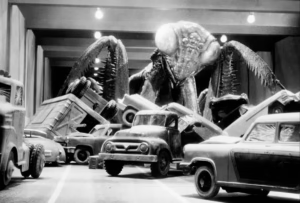
Image Courtesy of Universal Pictures
Monster from Green Hell blames cosmic rays for its super-sized wasps, which crash-land in the African jungles to menace indigenous tribes and a scientific expedition.
Monster from Green Hell has aged worse than the dead wasp drying in your windowsill, and was mostly an excuse for producer Al Zimbalist (who also wrought Robot Monster on an unsuspecting public) to reuse footage he had acquired from 1939’s jungle adventure Stanley and Livingstone.
Apocryphally, Monster from Green Hell’s lead was only cast because he looked enough like Stanley and Livingstone’s lead to match him from a distance in the stock footage.
The film’s highlight is its bizarre, charming giant wasps, built by Wah Chang (later of the original Star Trek).
British film The Strange World of Planet X (released in America as Cosmic Monsters) also employed cosmic rays as the culprit for its giant bugs, one of the only international films to draw influence from the American giant bug movies.
The other, which almost demands mention, is Toho’s Rodan, whose first act features a Them!-inspired horde of giant prehistoric bugs as an appetizer (literally) to its titular pterodactyl.
The End of the Atomic-Age Giant Bug Era
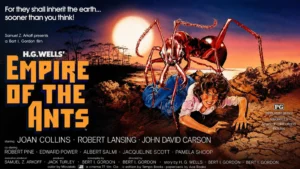
Image Courtesy of MGM-Amazon.
1957 and 1958 represented the pinnacle not only for giant bug films, but for the fifties science fiction horror boom as a whole.
Oversaturation brought on by the constant, low-quality churn of independently-produced sci-fi and horror films led quickly to audience fatigue.
Moreover, the vanguard of Europe’s sixties horror new wave had been ushered in by Hammer’s 1957 Curse of Frankenstein and 1958 Horror of Dracula.
The giant bug subgenre lapsed into dormancy, although giant bugs would crop up as secondary antagonists in sci-fi like 1961’s Mysterious Island and even a 1973 Doctor Who serial.
Bert I. Gordon would briefly revive the genre with Food of the Gods and Empire of the Ants, a reaction to the mid-seventies “nature’s revenge” film craze and the popularity of Jaws.
From Them! to Eight-Legged Freaks
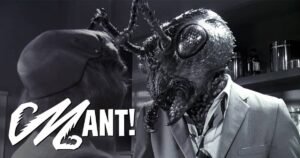
Image Courtesy of Universal Pictures.
Joe Dante would also pay tribute to the genre (and The Incredible Shrinking Man) with his movie-in-a-movie Mant!, part of 1990’s Matinee.
The most substantial tribute came from 2002’s Eight-Legged Freaks, a self-professed (through many clips from the 1954 film) spiritual successor to Them!
Even 2018’s Ant-Man and the Wasp would include a scene from Them! in its epilogue, proving that while the radioactive giant bug genre itself may be a product of its time, the films left a lasting impact on the imagination of generations of filmmakers.
Although the tropes, conventions, and storytelling of Them! or The Black Scorpion are old-fashioned, the fears at their heart are timeless, as we’ll always wonder whether we’ve at last pushed the frontiers of science too far.
If you liked this piece, check out other editorials penned by me!










Why the Big Bug Craze Was Atomic-Age Horror At Its Best (And Worst)

‘The Cannibal’: Gustaf Skarsgård to Explore Ingmar Bergman’s Demons in New Psychological Horror Film

Oscar-Winning ‘Son of Saul’ Director to Helm New Jack the Ripper Historical Thriller

Ron Perlman’s Horror Movie ‘Renew’ Wraps Production

‘The Exorcist: Martyrs’ Star Says Mike Flanagan’s Horror Movie Is His “Scariest” Yet

5 Horror Movies Coming to Theaters Before Halloween 2026

All the Horror Coming to Hulu, Netflix, Tubi & More in October 2026

Paperbacks from Hell: 5 Horror Films Based on ’70s and ’80s Pulp Fiction

50 Things to Do at Home for Halloween

Shudder Reveals Full October Horror Lineup for Halloween

‘New Group’ Trailer Unleashes Cosmic Body Horror on Shudder

‘Creature of the Pines’ Trailer Unleashes a Found-Footage Cryptid Nightmare in the Pine Barrens

‘Human’ Trailer Promises an Extreme, “Stomach-Churning” Supernatural Nightmare

‘The Institute’ Season 2 Trailer: Stephen King’s Gifted Teens Prepare to Fight Back This November
